Choosing a facelift surgeon in New York City begins with one essential principle: verify expertise before you evaluate aesthetics. You’re looking for board certification, facial specialization, and an anatomy-based surgical philosophy to achieve naturally beautiful results.
As a double board-certified facial plastic surgeon with advanced fellowship training in facial plastic and reconstructive surgery, Dr. Lee Ann M. Klausner’s Park Avenue practice is dedicated exclusively to the face and neck. Her philosophy centers on precision and restraint, never altering your expression, only restoring harmony.
In this blog, we’ll tell you how to choose a Facelift Surgeon in New York City and why you can trust Dr. Klausner with your procedure.
Terms to Know
- ABFPRS (American Board of Facial Plastic and Reconstructive Surgery): A specialty board focused exclusively on facial plastic surgery, requiring fellowship-level training and examination.
- ABOHNS (American Board of Otolaryngology–Head and Neck Surgery): Board certification in ear, nose, throat, and facial structures.
- FACS (Fellow of the American College of Surgeons): Indicates a surgeon meets high standards of education, ethics, and professional competence.
- AAAASF Accreditation: The American Association for Accreditation of Ambulatory Surgery Facilities certifies surgical facilities for safety standards.
- Deep Plane Facelift: A technique that repositions deeper facial tissues rather than only tightening skin.
- SMAS Facelift: Targets the superficial musculoaponeurotic system (SMAS), a foundational facial layer responsible for structure and support.
- Mini Facelift: A less extensive procedure focused on early jowling and mild laxity.
How to Verify and Evaluate a Surgeon
1. Confirm Board Certification
Board certification confirms completion of accredited residency training, a rigorous specialty examination, and ongoing adherence to ethical and professional conduct standards under the oversight of the American Board of Medical Specialties.
You can use the official ABMS public database to search for the surgeon by last name and state. You should see:
- The exact specialty board
- Confirmation that certification is active
- The physician’s specialty designation
Dr. Lee Ann M. Klausner is double board-certified by both the American Board of Facial Plastic and Reconstructive Surgery and the American Board of Otolaryngology–Head and Neck Surgery. This dual certification reflects advanced surgical training focused exclusively on the anatomy of the face, head, and neck, a level of specialization particularly relevant for facelift surgery.
Her additional distinction as a Fellow of the American College of Surgeons (FACS) signifies adherence to high standards of surgical ethics, education, and patient safety.
2. Confirm Subspecialty Focus
Not all board-certified surgeons specialize in facelift surgery. Look for:
- A practice devoted primarily to the face and neck
- Fellowship training in facial plastic and reconstructive surgery
- Regular performance of facelift procedures
Facial anatomy requires focused expertise. Surgeons trained specifically in facial structures develop a refined understanding of nerve pathways, aging patterns, and natural tissue repositioning.
3. Verify Facility Accreditation
Safety extends beyond the surgeon. Ask where surgery is performed. Accredited surgical facilities meet strict safety standards for equipment, sterility, and anesthesia protocols.
You can verify accreditation through the American Association for Accreditation of Ambulatory Surgery Facilities.
4. Evaluate the Consultation Experience
A qualified facelift surgeon will never rush the evaluation process. A thorough consultation should include:
- Detailed medical history review
- Facial analysis in multiple planes
- Discussion of surgical and non-surgical options
- Honest explanation of risks and limitations
- Clear recovery timeline
- Written cost transparency
5. Review Results with a Critical Eye
Before-and-after photography is not marketing; it’s documentation. When reviewing a surgeon’s gallery, look for consistency, transparency, and technical integrity. Authentic facelift results respect individual anatomy, and individual expression should remain intact.
Strong galleries should demonstrate:
- Standardized photography (same lighting, angle, background, and facial expression)
- Multiple views (front, profile, three-quarter)
- Neutral positioning without dramatic makeup, contouring, or filters
- Visible improvement in jawline definition and neck contour
- Natural skin tension without pulled corners of the mouth or distorted earlobes
- Preserved facial identity
Pay attention to subtle markers of surgical refinement:
- Smooth transitions at the hairline
- No abrupt contour irregularities
- Balanced facial proportions
- Scar placement that is discreet and anatomically appropriate
6. Ask About Technique, and Why It’s Recommended
There is no single “best” facelift technique. Options may include:
- SMAS facelift
- Deep plane facelift
- Mini facelift
The appropriate approach depends on anatomy, skin quality, facial volume, and degree of laxity. A responsible surgeon explains why a specific method suits you and why others may not. We’ll discuss this further later on.
7. Discuss Recovery and Longevity
Recovery varies by technique and individual healing patterns. A surgeon should outline:
- Swelling timeline
- Bruising expectations
- Return-to-work guidance
- Scar maturation
- Long-term maintenance strategy
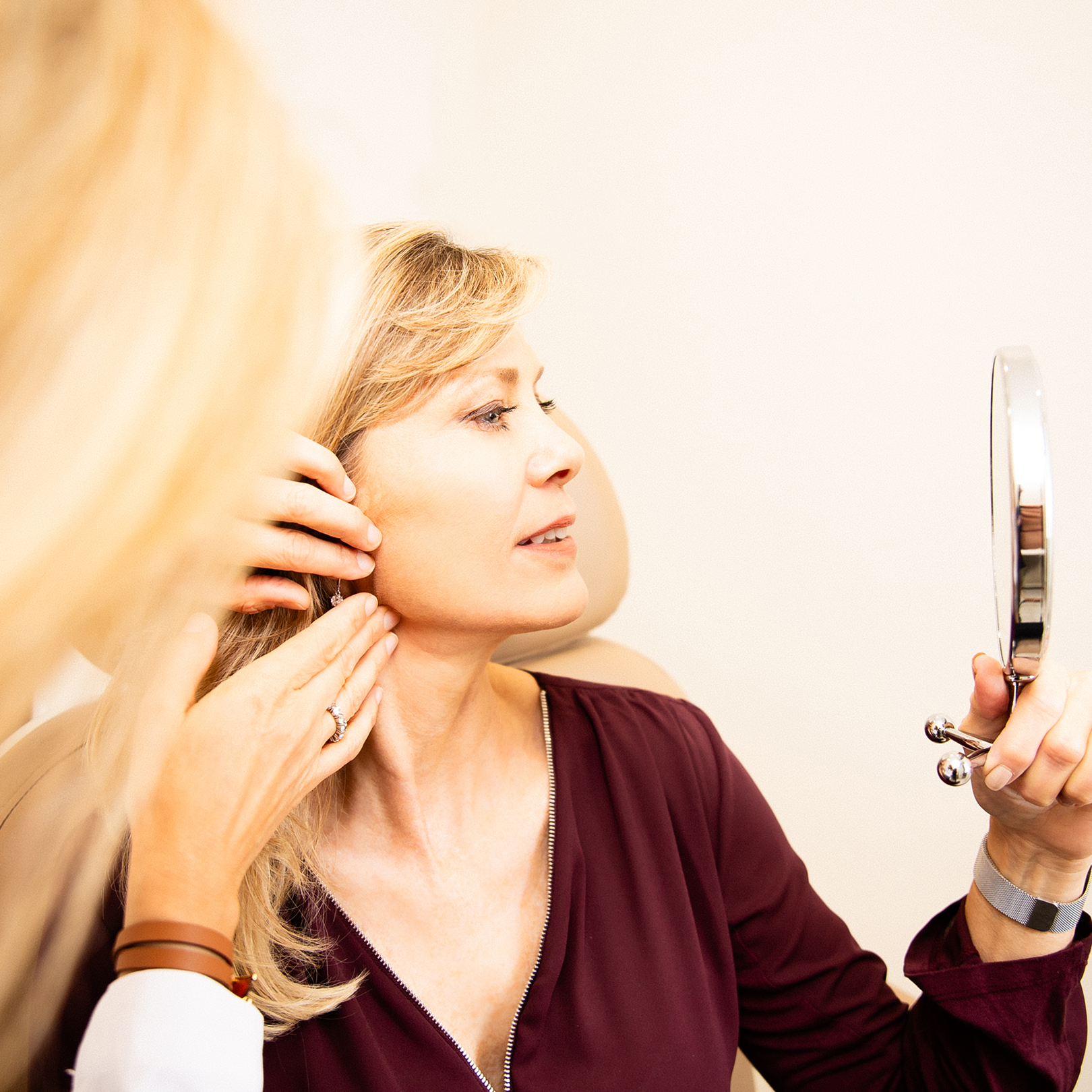
*Dr. Klausner performing a Facelift consultation
Comparing Facelift Surgeons in Manhattan: Credentials and Techniques
|
Category |
What to Look For |
Why It Matters |
|
Board Certification |
ABFPRS and/or ABOHNS (ABMS-recognized) |
Confirms formal specialty training and examination standards |
|
Fellowship Training |
Facial plastic & reconstructive fellowship |
Advanced refinement in facial techniques |
|
Primary Specialty |
Face & neck focus |
Greater anatomical expertise and procedural consistency |
|
Technique Offered |
SMAS, deep plane, mini facelift |
Tailored approach based on anatomy and goals |
|
Facility Accreditation |
AAAASF or hospital-based |
Verified safety standards |
|
Anesthesia Oversight |
Board-certified anesthesiologist or accredited team |
Reduced procedural risk |
|
Consultation Transparency |
Clear explanation of risks, recovery, alternatives |
Ethical, patient-centered care |
Facelift Cost Breakdown in Manhattan
According to the most recent national data published by the American Society of Plastic Surgeons (ASPS), the average surgeon’s fee for a facelift is approximately $8,005. Importantly, ASPS clarifies that this number reflects the surgeon’s professional fee only, not anesthesia, operating room costs, or related expenses.
In Manhattan, total costs often exceed national averages due to:
- Board-certified anesthesia teams
- Accredited surgical facilities
- Advanced techniques
- Geographic market factors
What Makes Up the Total Cost of a Facelift?
|
Cost Component |
What It Covers |
Why It Matters |
|
Surgeon’s Fee |
Professional fee for performing the procedure |
Reflects experience, specialization, and surgical expertise |
|
Anesthesia Fee |
Board-certified anesthesiologist or anesthesia provider |
Directly tied to safety and monitoring standards |
|
Facility Fee |
Accredited operating room, nursing staff, equipment |
Ensures sterile, regulated surgical environment |
|
Pre-Operative Evaluation |
Medical clearance, labs (if required) |
Confirms patient readiness and minimizes risk |
|
Post-Operative Care |
Follow-up visits, dressings, recovery guidance |
Supports optimal healing and long-term results |
Your consultation should include:
- A written, itemized estimate
- Clear explanation of what is included
- Discussion of technique-related cost differences
- Honest comparison of surgical vs. non-surgical alternatives
- No ambiguity. No bundled surprises. Transparency reflects integrity, and integrity is part of surgical expertise.
Questions About How to Choose a Facelift Surgeon in New York City? Let’s Talk.
When credentials are independently verifiable, when a practice focuses exclusively on the face and neck, when facility accreditation is transparent, and when consultation conversations are thorough rather than transactional, you can make an informed decision rather than guess.
Dr. Lee Ann M. Klausner holds double board certification and has completed fellowship training in facial plastic and reconstructive surgery. Her specialized expertise in facial anatomy reflects a career built on discipline, refinement, and accountability. Her Park Avenue practice is centered on individualized evaluation, conservative surgical planning, and achieving results that restore structure while preserving your unique identity.
Your features are uniquely yours, and they deserve specialized care. If you are considering a facelift in New York City, we encourage you to use this checklist and then experience the difference that precision, transparency, and dedicated facial expertise can make. Schedule your private consultation at the Klausner Institute today by calling (646) 568-6485.
Frequently Asked Questions About How to Choose a Facelift Surgeon in New York City
Should I choose a surgeon who performs a high volume of facelifts?
Quality is more important than quantity, but a surgeon's consistent experience with facelift surgery improves their skills and decision-making. Surgeons who frequently perform facelifts are better at recognizing anatomical variations, planning scar placement, and managing complications. It's advisable to inquire about how many facelift procedures they perform regularly.
How important is hospital privilege status?
Having hospital privileges is important, even for procedures in private surgical facilities. Hospitals evaluate a surgeon's credentials and safety record before granting privileges, adding an extra layer of accountability. Ask your surgeon which hospitals they are credentialed with.
Should I ask about revision rates?
Yes. While revisions are uncommon in skilled hands, understanding how often a surgeon performs revision facelifts can provide insight into their long-term outcomes and standards.
A thoughtful surgeon will discuss expectations realistically rather than promise perfection.
How can I assess a surgeon’s aesthetic philosophy?
During consultation, ask how the surgeon defines a successful facelift result. Do they emphasize structural restoration and natural tension? Or do they prioritize dramatic lifting?
Look for language centered around harmony, proportion, and identity preservation rather than transformation.
What questions should I ask about scarring?
Even when scars are discreet, placement and healing matter. Ask:
-
Where exactly incisions are placed
-
How tension is minimized
-
What post-operative scar care is recommended
An experienced surgeon will explain the timelines for scar maturation and show examples of healed incision sites.
How do I know if I’m being pressured?
Ethical surgical practices should avoid urgency tactics, time-sensitive discounts, or emotional manipulation. If you feel pressured to schedule, take a moment to reconsider. A responsible facelift surgeon promotes thoughtful decision-making and provides time for contemplation.