
Long-term sun exposure is one of the most common and underestimated causes of advanced facial aging. Over time, ultraviolet damage weakens collagen, reduces elasticity, and compromises the skin’s ability to heal and redrape smoothly. At the Klausner Institute in Manhattan, Dr. Lee Ann M. Klausner, M.D., a double-board-certified facial plastic surgeon and Castle Connolly Top Doctor, is uniquely qualified to address these concerns through a facelift approach that takes into account both facial anatomy and skin quality.
Her philosophy centers on restoring structure while preserving individual expression, allowing patients with sun-damaged skin to achieve refined, natural-looking rejuvenation. Read on to understand what a facelift can realistically accomplish when sun damage is part of the equation.
How Sun Damage Accelerates Facial Aging
Chronic ultraviolet exposure leads to progressive breakdown of collagen and elastin, the structural proteins responsible for skin firmness and recoil. As these fibers degrade, skin becomes thinner, less resilient, and more prone to laxity. In sun-damaged patients, this often presents as deeper perioral lines, pronounced jowling, reduced jawline definition, and uneven texture that extends beyond surface discoloration.
These changes are not purely cosmetic. Sun damage alters vascular supply and slows regenerative capacity, both of which influence how skin responds to surgical repositioning. For facelift planning, evaluating skin quality is just as important as assessing sagging or volume loss.
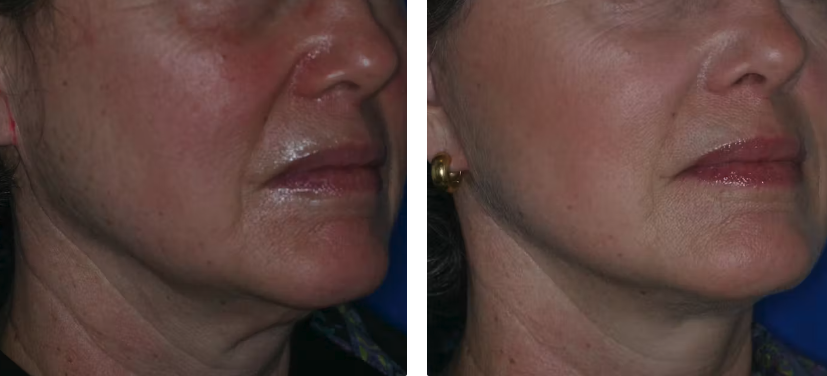
Is a Facelift Effective for Sun-Damaged Skin?
A facelift remains highly effective for patients with sun-damaged skin, provided the procedure prioritizes deep structural correction rather than surface tightening. Modern facelift techniques focus on repositioning the tissues that have descended, restoring youthful contours, and then allowing the skin to settle naturally over this new foundation.
For patients with compromised elasticity, this approach is essential. Relying on skin tension alone can produce unnatural tightness or short-lived results. Dr. Klausner’s technique emphasizes anatomical support first, ensuring the skin is redraped without strain and facial expression remains intact.
Key Surgical Considerations for Sun-Damaged Skin
During consultation, several factors are carefully evaluated to determine the safest and most effective surgical plan:
- Skin quality: Thickness, elasticity, and cumulative sun exposure guide incision placement and tissue handling.
- Healing capacity: Sun-damaged skin may require a more conservative approach to ensure predictable recovery.
- Facial anatomy: Underlying muscle position and fat distribution influence how lifting should be performed.
- Long-term care planning: Ongoing sun protection and medical-grade skincare are crucial for maintaining results.
By tailoring the procedure to these variables, Dr. Klausner avoids overcorrection and delivers results that age gracefully rather than abruptly.
Addressing Surface Sun Damage After a Facelift
While a facelift restores facial structure and contour, it does not directly treat pigmentation irregularities or textural changes caused by sun exposure. For this reason, many patients benefit from a staged treatment plan.
Once surgical healing is complete, non-surgical skin treatments may be introduced to improve tone, stimulate collagen, and refine texture. These treatments are timed intentionally to protect surgical results while enhancing overall skin quality.
Rejuvenation After Years of Sun Exposure
A facelift can be highly effective for patients whose appearance reflects years of cumulative sun exposure, but outcomes depend on surgical judgment, technical precision, and individualized planning. Dr. Klausner employs an anatomy-driven facelift approach that considers compromised skin quality while preserving natural facial expressions.
If sun damage has contributed to sagging, deep folds, or loss of definition, a personalized facelift consultation can clarify whether surgery is appropriate and how it should be performed. To explore your options, schedule a consultation with Dr. Klausner in Manhattan today and receive expert guidance grounded in experience, credentials, and a commitment to natural-looking results.