Schedule a Consultation
a more confident version of you
Contact Us


Recovery from blepharoplasty follows a fairly predictable arc. Bruising and swelling usually peak in the first week, and most patients return to work 10 to 14 days after an eyelid lift. Full healing generally takes two to four weeks, with subtler changes continuing beyond that.
Dr. Lee Ann M. Klausner is a double board-certified facial plastic surgeon and a Fellow of the American College of Surgeons who practices on Park Avenue in Manhattan. This guide walks through preparation, each stage of healing, activity limits, and the risks patients should understand before scheduling eyelid surgery.
Preparing for blepharoplasty in NYC starts with a thorough consultation and a plan for the first week at home. Dr. Klausner reviews each patient's medical history, current medications, and goals, then explains which approach may be best for their eyelids. Written instructions follow, and keeping to them closely can help the recovery go smoothly.
Common preparation steps may include:
The consultation also covers what to expect on surgery day. Eyelid surgery is performed on an outpatient basis, using either local anesthesia with sedation or general anesthesia, so patients go home the same day. Knowing the plan ahead of time tends to ease nerves and makes it simpler to organize help at home.
Patients scheduling eyelid surgery may want to clear the first week or so of their calendar. Those traveling in from Westchester or Greenwich can ask the team about staying nearby, since a long commute right after surgery may be uncomfortable.
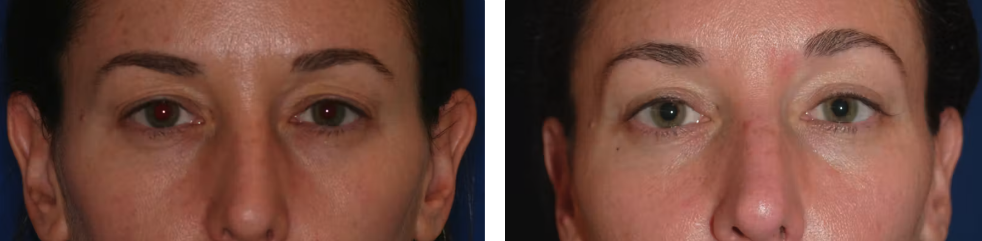
*Real Patient Results - Upper Blepharoplasty
The blepharoplasty recovery timeline spans roughly two to four weeks for visible healing, with subtle changes continuing for months. Patients commonly describe the experience as tight and sore rather than sharply painful, and the American Society of Plastic Surgeons notes that discomfort can be managed with medication, cold compresses, and ointment.
Swelling often looks uneven in the early days, with one eyelid appearing puffier or darker than the other. That difference is common while fluid drains, and it tends to even out as healing progresses. Swelling that increases quickly, or becomes painful on one side only, is worth a call to the office rather than a wait-and-see approach.
Healing speed varies with age, skin quality, and how closely aftercare is followed. Patients who combine eyelid surgery with a brow lift or facelift should expect a longer, more layered recovery.
Upper eyelid recovery tends to be more straightforward. The incision sits in the natural crease above the eye, where it often blends in as it heals, and many patients find that swelling is heaviest in the first few days before easing.
Lower eyelid surgery may involve an incision just beneath the lashes or inside the lid, and swelling in that area can last longer. Watery eyes, mild tightness, or a slight pulling sensation may appear while tissues settle. Dr. Klausner tailors aftercare to the technique used, so instructions can differ between upper and lower procedures.
Combined upper and lower procedures blend both patterns, and recovery may follow the slower of the two timelines. Planning for the longer window can take pressure off social calendars and work deadlines, particularly for patients with a busy schedule in Manhattan.
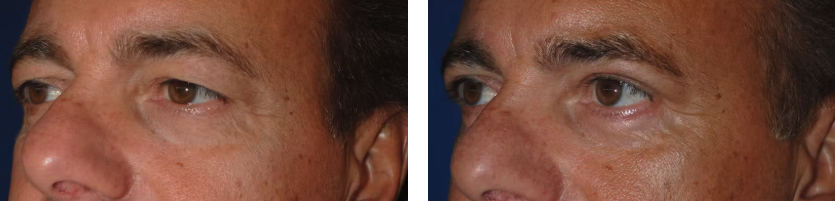
*Real Patient Results - Men's Upper and Lower Eyelid Surgery
Activity restrictions after blepharoplasty protect the incisions and limit swelling while the eyelids heal. The American Board of Cosmetic Surgery advises avoiding lifting, straining, and bending over for up to four weeks, because sudden jumps in blood pressure can stress tissue that is still closing. Typical guidelines may include:
Short stretches of reading and screen use are often manageable, but eyes may fatigue quickly for the first few weeks. Patients who work at a computer can consider returning part-time and building up gradually. Dr. Klausner's team provides personalized timelines for exercise, travel, and a full return to work.
Sun and wind protection deserves extra attention in a city where so much of the day is spent on foot. The American Society of Plastic Surgeons recommends diligent sun protection and dark sunglasses until healing is fully complete, and the American Board of Cosmetic Surgery adds that wind can irritate healing eyes. A wide-brimmed hat adds coverage on bright days.
Blepharoplasty risks and complications range from expected healing effects to uncommon surgical problems. Swelling, bruising, dry eyes, and temporary irritation are part of normal recovery. Less frequent complications can occur, and knowing about them in advance helps patients make informed decisions. Possible complications include:
Certain factors may influence risk, including existing dry eye, thyroid or circulatory conditions, smoking, and the number of procedures combined. A detailed medical history and eye evaluation before surgery help the team plan safely, and patients who share every medication and health condition give Dr. Klausner the information needed to tailor the approach.
Patients should contact the surgical team promptly for sudden vision changes, severe or one-sided pain, rapidly increasing swelling, or fever. Choosing a board-certified facial plastic surgeon and following aftercare closely may help lower the chance of problems. Dr. Klausner, board-certified in both facial plastic and reconstructive surgery and otolaryngology-head and neck surgery, reviews individual risks during every consultation.
Recovery is gradual, and clear expectations can make each stage easier to navigate. Dr. Klausner, who has been named among Castle Connolly's Top Doctors, offers eyelid surgery alongside brow lift and facelift options for patients who want a more comprehensive plan.
To discuss candidacy, timing, and a personalized recovery plan, schedule a consultation at the Klausner Institute on Manhattan's Upper East Side today.
This information is provided for educational purposes only and does not replace a consultation with a board-certified facial plastic surgeon. Outcomes, risks, and suitability vary from patient to patient.