A septal perforation repair is a surgical procedure that closes an abnormal hole in the nasal septum, the wall of bone and cartilage that separates the two nostrils. Left untreated, a perforation can cause whistling, crusting, bleeding, and chronic congestion.
Dr. Lee Ann M. Klausner, double board-certified in facial plastic and reconstructive surgery and in otolaryngology-head and neck surgery, has spent much of her NYC practice on the cases other surgeons turn away: perforations that failed a prior closure, defects large enough to be called inoperable, or septal damage tangled up in scar tissue from an earlier surgery.
This blog covers what causes a septal perforation, the surgical techniques used to close one, and how to evaluate a surgeon when your case is complicated or a previous repair didn't hold.
So What Is a Septal Perforation?
A septal perforation is a hole through the nasal septum that allows air to pass abnormally between the two nasal passages.
Unlike a deviated septum, which is a structural curve or displacement, a perforation is an actual defect in the tissue itself. Perforations range from small pinhole defects to large openings several centimeters wide, and size alone does not determine how disruptive the symptoms feel to a patient.
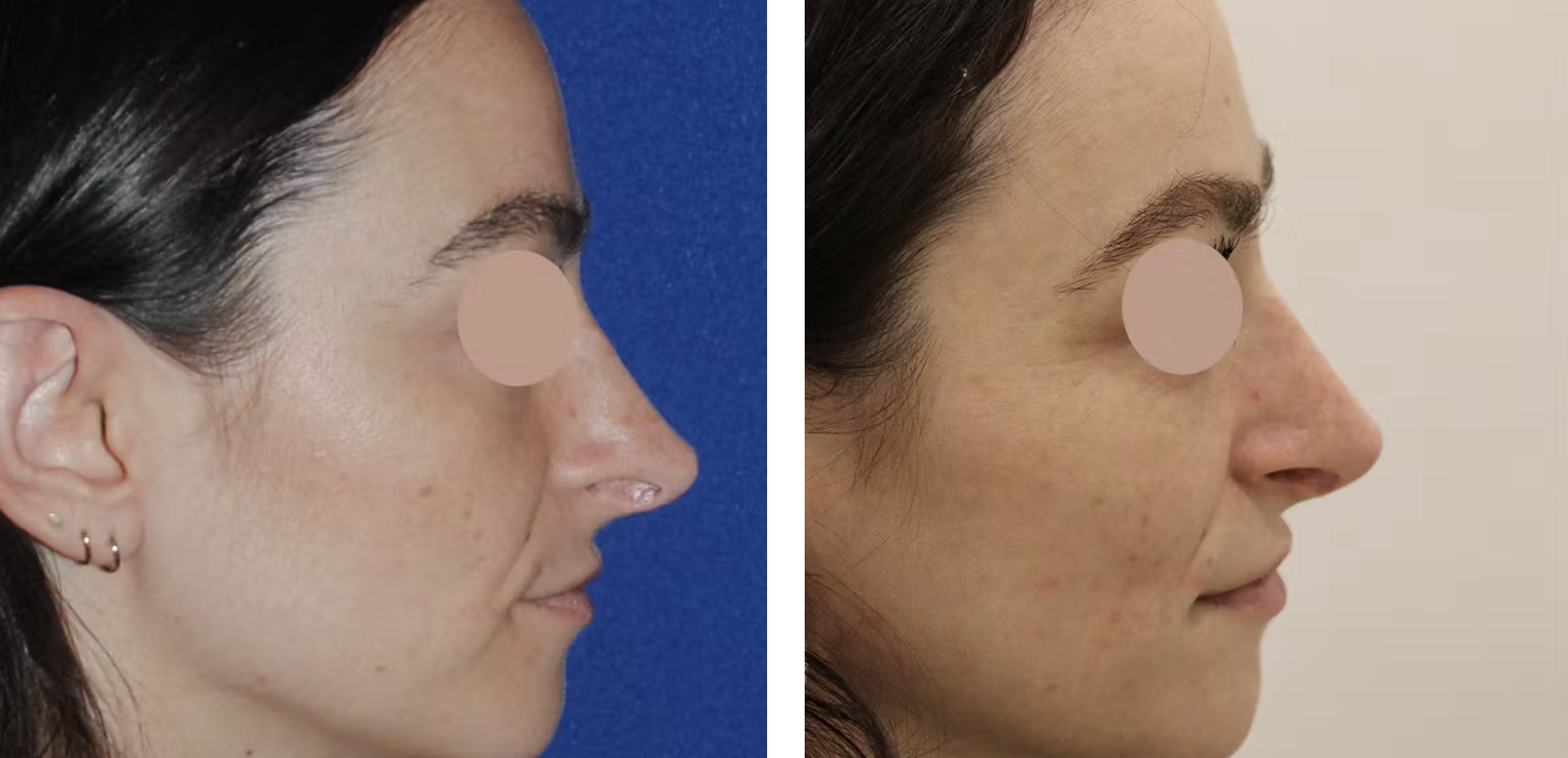
*Real Patient Results - Septal Perforation Repair at the Klausner Institute in Manhattan
What Are the Symptoms of a Septal Perforation?
Symptoms vary with perforation size and location, but most patients report a combination of the following:
- A whistling sound during breathing, especially with smaller perforations
- Chronic crusting inside the nose
- Recurrent nosebleeds (epistaxis)
- Nasal obstruction or a feeling of blockage
- Dryness and a sensation of pressure or pain
According to a systematic review published in the peer-reviewed journal Clinical Otolaryngology, nasal obstruction, crusting, and epistaxis are consistently the most commonly reported symptoms among patients with septal perforations.
What Can Cause a Septal Perforation?
Most septal perforations trace back to one of a few recognized causes. The most commonly reported causes in the literature include:
- Iatrogenic perforations resulting from a prior nasal surgery, such as septoplasty
- Trauma, including nasal injury or repeated nasal instrumentation
- Chronic nose-picking
- Cocaine use
- Autoimmune or granulomatous conditions
- Idiopathic, or cases where no clear cause is identified
Iatrogenic perforations are the most common cause reported in the literature, which is part of why revision cases so often involve a septum already altered by prior surgery.
Surgical Techniques Used in Septal Perforation Repair
Surgeons can approach septal perforation repair through an open, closed, or endoscopic technique. The right approach depends on the size and location of the perforation, the condition of the surrounding tissue, and whether prior surgery has already altered the anatomy.
Open Approach
- Full visibility of the perforation and surrounding septal anatomy
- Often preferred for larger perforations, where a wider defect needs more room to graft and repair
- Well-suited to revision cases, where scar tissue from a prior surgery makes the anatomy harder to navigate through a closed technique alone
- Uses the same external incision as open rhinoplasty, at the base of the nose
Closed Approach
- No external incision or visible scarring, as the approach works entirely through the nostrils
- Frequently used for smaller to moderate perforations, where the surrounding mucosa is healthy enough to mobilize without wide exposure
- Comparable closure outcomes to the open approach
- Choice often comes down to case specifics rather than one technique being universally superior
Endoscopic Approach
- Minimally invasive, with no external incision, as the repair happens inside the nasal passage
- Magnified visualization of the perforation margins through a small camera
- Avoids external scarring entirely
- Requires significant endoscopic experience to perform reliably on more complex defects
Why Layered Reconstruction Is Critical for Lasting Closure
Regardless of approach, the technique that most consistently determines whether a repair holds long-term is layered (or multilayer) reconstruction. This involves mobilizing mucosal flaps from both sides of the perforation and placing an interposition graft between them rather than attempting a single-layer closure.
A multilayer repair typically includes:
- Mucosal flaps mobilized from both sides of the perforation to cover the defect
- An interposition graft, often cartilage or fascia, placed between the flaps for structural support
- A mucoperichondrial layer, when available, added for additional coverage and blood supply
A ten-year retrospective study on endonasal septal perforation repair reported an 86 percent closure rate using this multilayer approach, combining:
- Cartilage interposition grafts
- Fascia grafts
- Mucoperichondrial flaps
Single-layer repairs, by comparison, tend to leave a thin, unsupported closure that is more prone to reopening under normal nasal airflow and crusting. This is one reason revision cases so often involve a prior surgeon who attempted a single-layer repair without adequate interposition support.
Success Rates and Outcomes for Septal Perforation Repair
- 91 percent overall closure, per a systematic review and meta-analysis of 64 studies covering more than 1,500 patients, with no meaningful difference between open and endonasal approaches
- 95 percent closure, per a separate case series using bipedicled mucosal advancement flaps, along with significant improvement in patient-reported nasal breathing scores
- Lower closure rates in certain cases, notably perforations caused by autoimmune disease, drug use, or foreign body trauma
- Increased technical difficulty in revision cases, since prior nasal surgery has been shown to complicate subsequent repair regardless of perforation size
Revision Repair: What to Do When a Previous Surgery Has Failed
When a septal perforation repair fails, it is usually because of one of a few recognized issues:
- A single-layer closure without adequate interposition support
- Inadequate blood supply to the tissue used to bridge the defect
- A perforation larger or more structurally compromised than the original technique could support
One study on the sandwich graft technique found that initial surgeries achieved an 84.6 percent success rate, with additional revision surgeries bringing the overall closure rate for the same cohort up to 88.5 percent, illustrating that a failed first repair does not mean the perforation cannot ultimately be closed.
Revision cases typically require:
- More extensive scar tissue management than a first-time repair
- A wider search for viable donor tissue, such as rib or conchal cartilage
- A surgeon experienced enough to recognize why the prior attempt did not hold
Patients who have been told a perforation cannot be closed after one failed surgery are often good candidates for a second opinion from a surgeon who regularly manages revision cases.
What to Look for in a Surgeon for Complex or Revision Septal Perforation Repair
Not every facial plastic surgeon regularly manages complex or previously failed septal perforation repairs, so patients researching this procedure should evaluate a surgeon's qualifications carefully before scheduling a consultation.
Look for:
- Dual board certification. Certification in both facial plastic and reconstructive surgery and otolaryngology-head and neck surgery indicates training in both the aesthetic and functional anatomy of the nose.
- Documented experience with revision cases. Ask directly how many septal perforation repair revisions the surgeon has performed, not just how many first-time repairs.
- Comfort with multiple techniques. A surgeon who can move between open, closed, and endoscopic approaches, and among different graft materials, can tailor the repair to the specific anatomy rather than forcing a single technique to fit every case.
- Willingness to take on declined cases. Surgeons who specialize in complex repair often see patients who a previous surgeon told that closure was not possible.
- A thorough pre-surgical evaluation. This should include a physical exam of the perforation's size, location, and surrounding tissue quality, as well as a review of prior operative notes for revision cases.
Why Patients Choose Dr. Lee Ann M. Klausner for Septal Perforation Repair
Dr. Lee Ann M. Klausner is double board-certified by the American Board of Facial Plastic and Reconstructive Surgery and the American Board of Otolaryngology-Head and Neck Surgery, and she is a fellow of the American College of Surgeons. She completed her residency in Otolaryngology-Head and Neck Surgery at NYU School of Medicine and her fellowship in facial plastic and reconstructive surgery with Dr. Russell W.H. Kridel in Houston, a surgeon widely known for advanced septal perforation repair.
Dr. Klausner has been recognized as one of Castle Connolly's Top Doctors and New Beauty's Top Beauty Doctors, and she has a documented record of successfully closing large, complex perforations that other surgeons deemed unreparable.
Dr. Klausner's dual training in facial plastic surgery and otolaryngology allows her to evaluate both the functional and aesthetic aspects of your case. Schedule a consultation at the Klausner Institute to discuss whether your perforation is a candidate for repair.
*Disclaimer: This information is provided for educational purposes only and does not replace a consultation with a board-certified plastic surgeon. Outcomes, risks, and suitability vary from patient to patient.

Sources
- Sharma, R. et al. "Paediatric Nasal Septal Perforations Systematic Review: Etiologies, Symptoms, and Treatment Outcomes." Clinical Otolaryngology, 2025. https://onlinelibrary.wiley.com/doi/10.1111/coa.70010
- "Surgical repair of nasal septal perforations: A systematic review and meta-analysis." PubMed, 2022. https://pubmed.ncbi.nlm.nih.gov/34978162/
- "Predictors of Success of Endonasal Septal Perforation Repair: A 10-Year Experience." PubMed, 2023. https://pubmed.ncbi.nlm.nih.gov/37782906/
- "Sandwich graft technique outcomes in medium and large size nasal septal perforations." ScienceDirect, 2021. https://www.sciencedirect.com/science/article/pii/S1808869421000161
- "Septal perforation: Comparative analyses of repair failure by etiology." Plastic and Aesthetic Research, 2024. https://www.oaepublish.com/articles/2347-9264.2023.109