Schedule a Consultation
a more confident version of you
Contact Us

Eyelid surgery is medically necessary when drooping or excess upper eyelid tissue interferes with vision, such as when skin blocks the upper field of view. That distinction shapes the evaluation and, in many cases, whether insurance may contribute to the cost. For patients exploring eyelid surgery in NYC, functional blepharoplasty is the version aimed at improving the field of view.
Dr. Lee Ann M. Klausner, M.D., FACS, is double board-certified in facial plastic and reconstructive surgery and in otolaryngology-head and neck surgery, and she sees patients at the Klausner Institute on Park Avenue in Manhattan. This guide covers what functional blepharoplasty involves, how to tell whether eyelids are affecting vision, how coverage works, and where Asian blepharoplasty fits.
Functional blepharoplasty is eyelid surgery performed to address a medical concern, most often excess upper eyelid skin that blocks part of the visual field. According to Medicare policy, upper blepharoplasty and ptosis repair are considered functional when excess tissue or lid position produces visual complaints, typically with straight-ahead gaze or reading position. Upper eyelid surgery is reconstructive when it provides functional vision or visual field benefits, and cosmetic when it is done to enhance appearance.
Several conditions may support a functional approach, either alone or in combination:
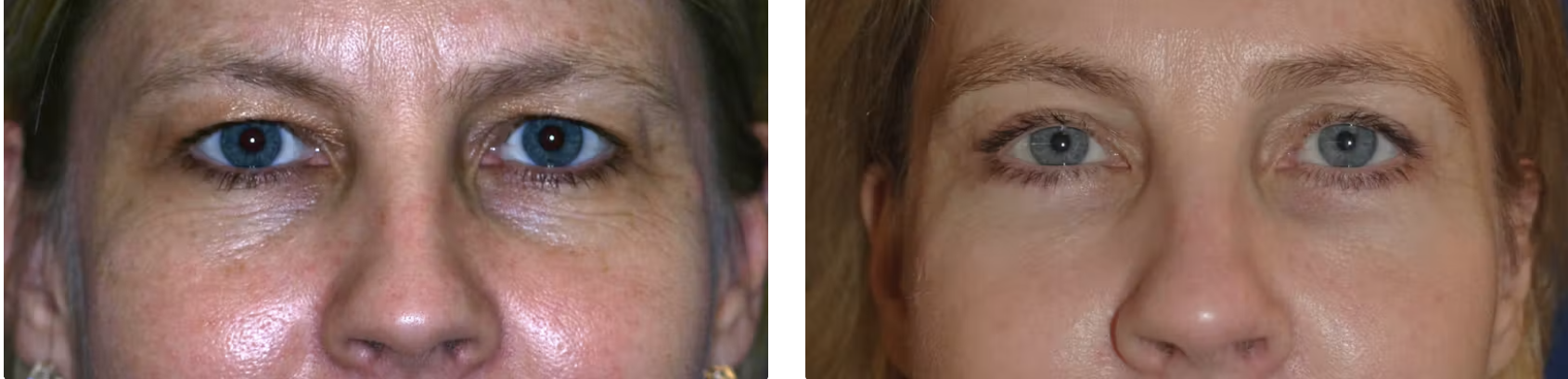
*Real Patient Results - Eyelid Surgery performed by Dr. Lee Ann M. Klausner
Dermatochalasis is excess eyelid skin with reduced elasticity, most often a result of aging. Over the years, the skin loosens and can fold over the lash line, and gravity and genetics may also play a role. It differs from ptosis, where the lid margin itself sits low, and from pseudoptosis, in which the lid margin sits in a normal position but excess skin overhangs it enough to create its own droop. Blepharochalasis, a related condition, involves excess skin associated with chronic recurrent eyelid swelling that stretches the skin. These conditions can coexist, so a thorough evaluation looks at the lids and brows alongside visual field results.
Eyelids may be affecting vision when skin or lid position blocks the upper field of view during everyday tasks such as reading. Take note of complaints such as:
Evaluation typically includes photographs and visual field testing, with each eye tested at rest and again with the upper lid gently lifted or taped to estimate what surgery might change. One Medicare contractor's published criteria call for at least a 12 degree or 30 percent loss of upper field of vision, measured with the lid at rest and elevated, to show potential correction. Other insurers may set different thresholds, so documentation matters.
Blepharoplasty may improve the upper field of vision when excess eyelid skin is the cause of the blockage. Surgery removes or reshapes redundant tissue so it no longer hangs over the lashes, and the visual field test helps show how much of the obstruction the skin accounts for. Patients with a significant measured loss may be stronger candidates than those with mild symptoms, which is one reason testing comes before any recommendation. Brow ptosis may contribute to superior visual field loss, and it asks that the need for each planned procedure be documented separately. Results vary from patient to patient, and when ptosis or a low brow is also involved, ptosis repair or a brow lift may be considered alongside it.
Many insurance plans cover functional blepharoplasty when documented medical criteria are met, though requirements vary and approval is never guaranteed. A 2024 cross-sectional analysis of 70 American insurance policies found that 96 percent provide coverage for blepharoplasty. The most common covered indication, appearing in 80 percent of policies, was dermatochalasis causing functional visual impairment, which commonly requires visual field testing.
Coverage generally applies to the functional portion of surgery. Medicare does not cover cosmetic surgery, and private plans may draw the same line, so a procedure performed for appearance alone may be self-pay. When functional and cosmetic goals overlap, such as upper lid surgery paired with lower lid work, patients may want to request an itemized estimate that separates the two. Lower eyelid surgery may be treated as reconstructive in specific situations, such as poor lid tone that causes tearing or corneal exposure.
Because criteria differ between insurers, patients are encouraged to review their plan's blepharoplasty policy and ask about prior authorization before scheduling. Some documentation may be needed, such as:
Asian blepharoplasty, often called double eyelid surgery, creates or refines the upper eyelid crease, which some people are born without or have in a low or subtle position. It is generally an aesthetic procedure, so it differs from functional blepharoplasty, though a patient with heavy upper lids may have both concerns evaluated at once. Planning focuses on how the crease fits the lid anatomy and the overall balance of the eye area.
Techniques may include incisional methods, which define a crease through a small eyelid incision, and suture-based methods, which may involve little or no incision. The right approach can depend on factors such as:
Patients considering Asian blepharoplasty may want a surgeon who plans around individual anatomy rather than a single template. Dr. Klausner's philosophy centers on helping patients still look like themselves, and a consultation at the Klausner Institute is the place to discuss whether double eyelid surgery fits their goals.
Dr. Klausner, a fellow of the American College of Surgeons and a Castle Connolly Top Doctor, can evaluate whether heavy upper eyelids are affecting vision and discuss options at her Manhattan practice. Schedule a consultation or call (646) 568-6485 to start a conversation about functional blepharoplasty in NYC.